
Before Our First Shipment Went Out, We Redid the Packaging Three Times
Six excavators to Tanzania: version-one crates collapsed, version two let in condensation and rusted, version three added moisture barrier and steel strapping. The first two versions wasted 16,000 yuan — but after version three, fourteen machines shipped without a problem.
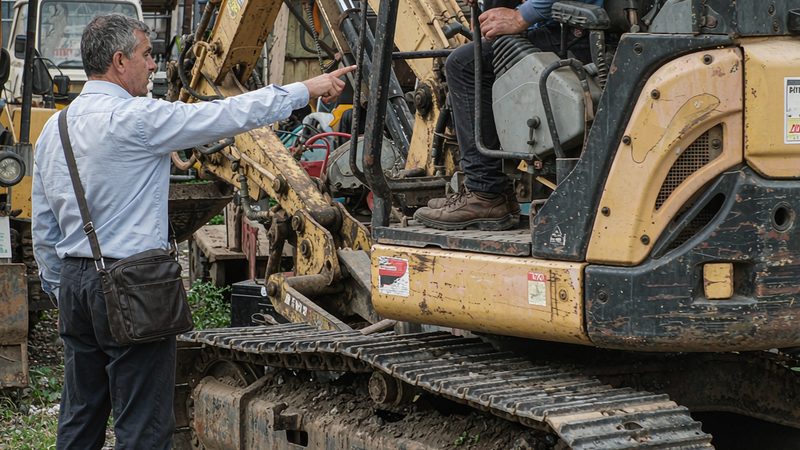
In April 2015 we signed our first full-container export order: six used excavators to Tanzania — two Komatsu PC200s and four Cat 320s — destination Dar es Salaam.
The night we signed, I couldn't sleep. Not from joy — from fear. That shipment was worth 1.8 million RMB, and those six machines carried most of our working capital. The boss said: if the cargo dies at sea, the company dies with it.
Every machine had been inspected, but nobody knew packaging. Before this we'd only shipped semi-knocked-down units and parts.
Bare machines wouldn't do. Forty days at sea — waves over the deck, knocks on the dock, the stevedores' wire slings — any one of them could wreck a cab or a hose. Wooden crates were a must.
Version one: the crates collapsed
For version one we used a local crate shop in Panyu — fir boards, 1.5 centimeters thick. The shop owner thumped his chest: ten years crating furniture, what's a machine to worry about?
The day the sample crate was done, we dropped a one-ton counterweight in to test. The forklift had lifted it twenty centimeters off the ground when the bottom cracked with a snap — two splits.
The crate man said, just have the forklift set it down gently. I said: forty days at sea — lifted once from Panyu to Nansha Port, once onto the ship at Nansha, once off the ship in Dar es Salaam, once more unloading for inland haul. Can you guarantee gentle every single time?
He had nothing to say. We walked away from that batch of crates — 8,000 yuan of deposit down the drain.
Version two: no moisture protection
For version two we switched to pine, board thickness up to two centimeters, crossbeams added to the base. We tested with two tons of counterweight, ten lifts — no problem. Strength: passed.
On May 12 we stuffed the containers — six machines into three forty-foot boxes. The sun was fierce that day; I sweated through my shirt, but inside I felt it was settled.
For the next forty days I checked that ship's position on the vessel-tracking sites every day. Right up until I saw the rust photos, I was still calculating how much the deal would make.
The ship arrived at the end of June. Our customer Mohammed sent photos back. The cab floor plates of three machines had rust spots; the hydraulic hose fittings carried a white, frost-like mold.
It wasn't seawater — it was condensation. The day-night temperature swing at sea is big: the air inside the crates soaked up moisture by day and sweated it out by night. Forty days of that is like steaming the machines slowly in a humid can.
The contract said cosmetic issues don't affect use — no grounds for a claim. But the customer's next sentence was: I'll need to think again about the next order.
That sentence costs far more than any claim.
Version three: moisture barrier and steel strapping
For version three, Lao Wang, Lao Li, and I changed four things.
Board thickness up to 2.5 centimeters; base crossbeams from two to three; load rating set at 1.5 times the machine's own weight.
Each machine wrapped first in stretch film, then bagged in aluminum-foil moisture barrier, seams sealed dead tight with butyl tape, and the cab given an extra layer of its own.
Twelve one-kilogram desiccant packs per machine, fixed at the four corners and under the cab seat.
Two bands of steel strapping outside. Bolts instead of nails to close the crates — so they can be reused at the destination. The customer flipped his crates over and used them as tool sheds.
After the changes we test-packed one machine. Lao Wang packed while I timed it: two hours forty minutes per machine. Slow — but every step was photographed.
Before loading we did one more test: dumped two buckets of water over a wrapped sample machine, waited two hours, opened it — dry inside.
The math after the change: packaging cost per machine went from 1,900 to 3,100 yuan. Desiccant 1,800, barrier film 2,200, strapping and bolts 900, labor extra. Six machines — 7,200 more.
Money spent and pits avoided
The first two versions, deposit plus rework, wasted 16,000 yuan. For version two's rust, we paid out of pocket to ship rust remover and touch-up paint — 3,800 in freight and materials.
But after version three, we shipped fourteen machines on the same route without a single packaging failure. Mohammed received his cargo and sent back an unboxing video on his own initiative — the floor plates were dry.
Later I did the math: if batch two had rusted again, that customer was gone. He went on to refer five customers to us in a year — five road rollers and three excavators' worth of business.
The fir-crate shop came back to us later, offering thicker boards. I said it was never about the boards — you never thought about the crate spending forty days at sea. He stood there blank for a while.
With packaging, the money you save is visible; the money you pay out isn't. While we could only see the former, we lost 16,000.
Photos of all three packaging versions are still on my computer, filed by year. Version one's cracks, version two's rust spots, version three's steel strapping — all there.
Three things you can demand before shipment
One, photos from loading day, taken before the moisture barrier is sealed — showing the machine, the desiccant, and the in-crate bracing.
Two, the desiccant count and placement, written into the packing list, checked against it on arrival.
Three, an unboxing video at the destination, starting from the moment the strapping is cut — don't stop the camera midway.
When something goes wrong, these three things make clear whose responsibility it is. When it can't be made clear, we take it.