
With Every Trade Fair Canceled, We Took Machine Viewing Online
This year's Canton Fair moved online, so we built a livestream studio inside our Panyu warehouse: fourteen sessions over five days and 216 new customer WeChat contacts. It cannot match the offline fair, but it reached people we could never reach before.
At four in the afternoon on November 30, the last livestream ended. Xiao Wang switched off the lights. I sat on a forklift in the warehouse scrolling through the backend numbers: five days, fourteen streams, 3,900 cumulative views, 216 WeChat contacts added, 89 inquiries received.
That is the report card from this year's Canton Fair. No comparison to the offline fair, but given that at the start of the year I expected nothing at all, I was content.
The Booth Moved from Pazhou to the Warehouse
In past Octobers we had a 36-square-meter booth in the Pazhou complex, showing one excavator and one wheel loader, hosting six or seven hundred visitors over five days and collecting a stack of business cards. In March this year we got the notice: the Canton Fair was going online.
Nobody had experience with an online fair. At the end of May we held a meeting and settled the plan: no flashy virtual showroom; we would livestream from inside the Panyu warehouse, real machines on camera, customers inspecting over the screen.
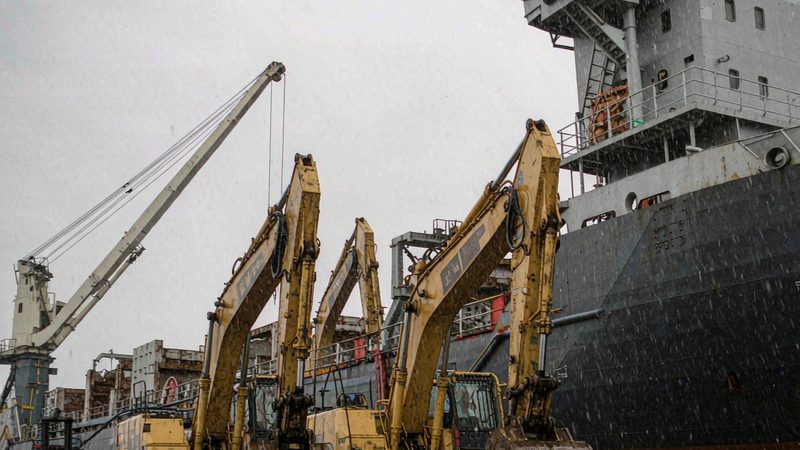
The gear was simple: two phones, one fill light, one lavalier mic, under 2,000 yuan all in. The backdrop was the warehouse itself, forty-some machines parked there, better than any decoration money can buy.
The rehearsal flopped. On the first test stream, Lao Li fired up the excavator to run the functions, and the moment the engine roared, the mic was nothing but noise; viewers were shouting that they could not hear. After that we separated narration from action: narrate with the engine off, run the functions in silence with captions. Only then did it flow.
What Happens in the Livestream
The fourteen streams fell into three types.
Type one: machine walk-arounds. Circle each machine, start it up, run the functions: boom lift, swing, bucket open and close. Whatever machine a customer wants to see, that is what we show. Lao Li operated, I narrated, Xiao Wang held the phone.
Type two: inspection demos. We walk customers through our sixty-three-point inspection process: calipers on bucket teeth, flashlight on welds, pulling the dipstick and smelling it. This was the most popular session; on November 27, concurrent viewers peaked at 420. One customer fired off seven questions in a row in the comments, all about pin clearance. You could tell he knew machines.
Type three: Q&A. Freight rates, transit time, payment methods, who to call when something breaks. Freight came up the most; by then a 40-foot container from Nansha to Mombasa had risen to US$3,200. I could only tell the truth: it would go higher.
An hour and a half before each stream, Lao Li started the machine to warm it up, Xiao Wang checked the lighting, and I went over the outline, not a script, a dozen bullet points on a cardboard sheet. By day three we had learned the trick: you must show a machine within the first three minutes or everyone leaves.
How Much Worse Than Offline
Honestly? Much worse. At last year's offline fair we signed nineteen letters of intent on the spot. This year online, deals closed within a month of streaming: seven.
Trust does not build through a screen. The customer cannot see the body filler under the paint or feel the track tension. Three customers got all the way to the payment step and then said, let's wait until I can fly to China. I understand; in their place, I would not wire over a hundred thousand dollars off a phone screen either.
Language was a problem too. Our English is workable, but French- and Portuguese-speaking customers were beyond us. During two streams a crowd of Brazilian customers came in, filling the chat with Portuguese. We fumbled through with translation software and watched them drift away. After the session I had Xiao Wang note down their contacts, and we had a translator reply to their emails one by one over the next two days.
Costs, though, were way down. Last year's offline fair, booth fee, construction, sample machine transport, ran 110,000 yuan. This year's livestreams: 2,000 in gear, 8,000 in paid traffic, under 10,000 total. It saved money, not effort; after five days my voice was gone for three.
The Unexpected Gains
But there is one account that cannot be computed offline: of the 216 new contacts, more than forty had never been to China before.
Two from Zambia, three from Mwanza inland in Tanzania, and a few from the Middle East. These people never came to the fair, not for lack of demand, but because flying to Guangzhou was too expensive and the visa too much trouble. Now they inspect machines lying at home.
The Mwanza customer is in gold mining. He used to buy machines through middlemen in Dar es Salaam, paying two layers of markup per machine. On the stream he looked at three excavators and asked very precise questions: bucket capacity, hours, track shoe width, all on point. In November he ordered his first machine directly from us, saving the middleman's cut, and we earned four points more than selling to the middleman.
There was another unexpected use. When old customers want to see new inventory, we used to have to take photos and email them, two or three days round trip. Now we pull them into the livestream and they decide on the spot. In November, an old Tanzanian customer watched twenty minutes of a stream and ordered a wheel loader: from first look to deposit, two days.
When offline fairs come back, we are not stopping the streams. The people you meet at Pazhou are fate; the people on the other side of the screen are business too. If the fair opens next year, we will put a sign at our booth with our streaming schedule, so the ones who cannot make it have somewhere to find us.