
Why African Customers Trust Japanese Brands
On job sites in Dar es Salaam, eight of ten excavators are Japanese. It's not brand worship — it's a thirty-year loop of parts, operators, and repair shops. This article is about that loop, and how we advise our customers.
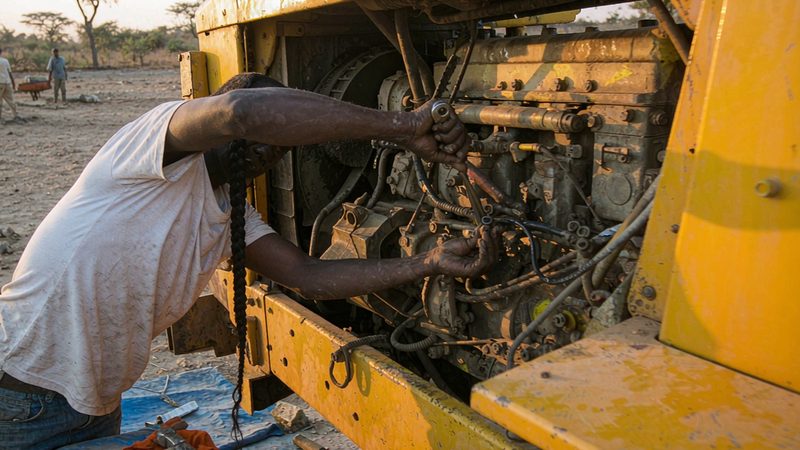
Walk around any job site in Dar es Salaam and eight of the ten excavators are Komatsu, Hitachi, or Caterpillar.
Last month at our warehouse, a Kenyan customer spent a whole afternoon circling two machines. One Komatsu at 440,000; one Chinese-made at 310,000. He bought the Komatsu in the end. This article is about why, and about how we advise our customers.
Installed base decides everything
Japanese brands hold upward of seventy percent of the used construction machinery market in Tanzania. That's not brand worship — it's historical path. And that seventy percent isn't from a statistics bureau; we counted machines one by one at job sites and repair shops.
In the eighties and nineties, Japanese aid projects and trading companies brought huge fleets into East Africa — building roads, ports, power stations. More machines meant more parts; more parts meant repair shops stocked them; once the shops could fix them, operators were willing to run them.
Over those thirty years, the Japanese trading houses opened offices in Dar es Salaam, built parts warehouses, and trained operators. That wasn't built by advertising. It was built by people.
The loop has been turning for thirty years. Any new brand has to start the wheel from zero and turn it year by year. There's no shortcut.
The title of this article is a question. Honestly, I don't have a complete answer. I'm just laying out what I've seen.
Can you get the parts?
What customers calculate is downtime. One excavator down for a day costs the site three or four hundred dollars, and schedule penalties come on top.
A hydraulic pump for a Komatsu 200: the aftermarket version is available in Dar es Salaam the same day, the OEM one in three days. The same pump for an obscure brand has to come from Dubai — one to two weeks.
We have a customer, Joseph, who runs a repair shop. His parts storage is organized by brand: Komatsu gets a full wall, Hitachi half a wall, Caterpillar three shelves, and every other brand combined gets one shelf.
I pointed at that shelf and asked him why. He said, it's not that I don't want to fix other machines — the parts take too long to arrive. The owners can't wait, and neither can I.
Aftermarket parts are cheap and quality varies. But customers don't fear uneven quality — they fear having nothing at all. If the part exists, work goes on.
What the operators can drive
Local operators learn their trade on Japanese machines, master teaching apprentice, twenty years of it. The training schools use Japanese machines as teaching aids too, so graduates put "can operate Komatsu, can operate Caterpillar" on their resumes.
Control layout, gauge markings, what each warning light means — he knows it with his eyes closed. Put him on a machine with a different layout and he needs half a month to adjust. That half month means slow output and misoperation — and one misoperation on a hydraulic cylinder costs thousands.
Customers buy equipment with the operator in mind. A machine that's twenty thousand cheaper but the operator can't drive? They don't want it.
I once saw a customer buy a cheap machine. His operator ran it for three days and wrecked the pilot system. The repair bill ate the entire price difference.
Chinese brands are changing
Since 2013, the shift of Chinese brands in Africa has been visible to the naked eye.
New machines from SANY and XCMG are showing up on sites in Kenya and Nigeria. New machines come with warranty, parts flow through the factory channel, and the operators brought over by Chinese crews know how to run them. Reputation is accumulating.
We've talked with the export departments of Chinese manufacturers. They're building parts warehouses too — but in Nigeria and Kenya. Tanzania still has to wait.
But in the used market, Chinese machines still circulate slowly. The core problems are the same two: few parts outlets, and operators unfamiliar with the machines. Dealers offer low prices for trade-ins, owners don't want to sell, and the market can't spin up.
My judgment: give it five more years and acceptance of Chinese machines in the used market will clearly rise. Not yet, though. I could be wrong — but we stock inventory according to this judgment.
How we advise our customers
If the budget allows, we recommend a Japanese machine with under eight thousand hours. Expensive, but easy to resell and low downtime risk. Run it three years, sell it, and the loss is small.
If the budget is tight, we offer two options: an older Japanese machine with high hours — cheap, with parts as a safety net; or a Chinese machine from the last two years, still under warranty — a bet on the factory channel.
For customers who choose a Chinese machine, we do one extra thing: we throw in a set of wear parts with the shipment — filters, belts, hoses — worth about two thousand. Our money, patching the gaps in the parts network.
There's also a middle path: buy a Japanese machine with a good undercarriage but a tired upper structure, and refurbish it. Refurbishment runs twenty to thirty thousand, and the total still comes in low. We keep these in the warehouse.
The Kenyan customer from the beginning — when he picked up his machine, I gave him an extra set of filters. He said he'd come back to me for his next machine. And when that time comes, maybe he'll give a Chinese machine a try.
Make a customer wait two weeks for a part and he'll never buy that brand again. Fix it the same day and he'll tell everyone he meets. That's how reputation works — built one day at a time.
The day that Kenyan customer took his Komatsu, his operator tested it in our yard for an hour. The operator climbed down and nodded at him. That nod was worth the 130,000 price difference.
Customers don't believe in brands. They believe in downtime days. Whoever keeps their downtime short earns their loyalty. That logic holds in every market.