
Three Pits We Fell Into Exporting Solar PV Modules
Four years in solar PV module exports — we've lost money and been cursed out by customers. Three pits, each bought with real cash, written down so you can avoid them.
We started exporting solar PV modules in 2018. This is our fourth year.
We've hit plenty of pits in four years. Here are the three most expensive.
Pit one: inflated power ratings
In 2019 we took a 300 kW order from a customer in Pakistan.
The supplier's quote said 450-watt modules.
We shipped without third-party testing.
When the cargo arrived, the customer had a local lab test it. Actual power: 428 watts — 4.9 percent low.
The industry standard tolerance is generally within plus or minus 3 percent.
The customer demanded a return, or a price adjustment to the actual wattage.
On a 300 kW shipment, the adjustment came to 110,000 yuan.
We went to the supplier. They said 450 was the factory rating — the test method was just different.
A month of wrangling later, we paid the customer 80,000 and the supplier covered 30,000.
We lost 50,000.
What we changed
One, every batch of modules gets third-party power calibration before shipment.
We work with three labs, sampling every batch. Sampling rate: three per thousand, but never fewer than five modules per batch.
Testing costs 320 yuan per module — twenty modules a container, that's 6,400.
We pay it. The customer doesn't.
Two, the contract spells out the test standard (STC conditions) and the allowed plus-minus tolerance.
Three, supplier qualification. We now work with only five suppliers, and we've walked the production line of every one.
Pit two: insufficient packaging
In 2020, a shipment arrived in Kenya and seventeen modules were found broken at unboxing.
Six hundred modules in that shipment; seventeen broken — a 2.8 percent breakage rate.
We dug into the cause.
The modules stood upright in wooden crates with foam dividers. But ocean vibration shifted the dividers, and the modules knocked into each other.
On top of that, the shipment was handled once at a transshipment port, and a forklift clipped a crate.
What we changed
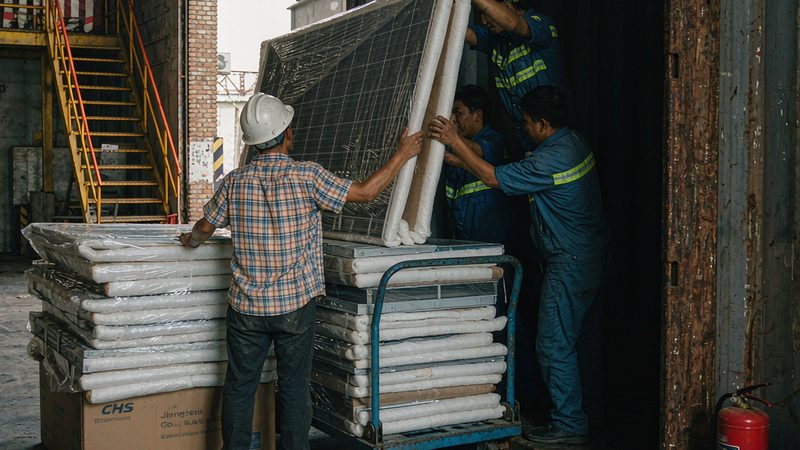
One, palletization. No more loose wooden crates — modules are packed as whole pallets, twenty per pallet, stretch-wrapped with corner protectors.
Two, better interlayer padding. From foam board to EPE pearl foam, thickness up from 5 mm to 10 mm.
Three, photos at loading, kept on file. One shot per layer as it's placed, one more before the doors close.
Four, breakage responsibility written into the contract. Breakage above five per thousand on arrival — we reship at our cost.
After the change, breakage dropped from 2.8 percent to under three per thousand.
Packaging cost per container rose 2,800 yuan — but claims fell by over a hundred thousand.
Pit three: inverter matching
The most hidden pit, and the most expensive.
In 2021 we supplied modules and inverters for a customer's 500 kW project.
The modules were ours; the inverters were a brand the customer specified, procured by us on their behalf.
After installation and grid connection, generation came in 13 percent below the design figure.
The customer came to us.
We investigated for two months. The root cause: string voltage mismatch.
The modules' operating voltage ran high, and at low temperatures the string's open-circuit voltage exceeded the inverter's maximum DC input limit.
To protect itself, the inverter derates.
In other words, all winter the system ran throttled.
Why we missed it
Because at design time we calculated string voltage only under standard conditions — we never checked it against the local extreme low temperature.
Winter lows there hit minus nineteen degrees Celsius. Module temperature coefficients are negative: the colder it gets, the higher the voltage.
At minus nineteen, open-circuit voltage was 17 percent above standard conditions.
Past the inverter's ceiling.
What we changed
One, extreme-temperature checks added to the design template.
For every design, the local record low and record high must be entered, and string voltage verified against the inverter's allowed range.
Two, DC/AC ratio disclosure.
Every proposal states the ratio of DC-side capacity to AC-side capacity, and what that ratio does under different irradiance conditions.
Three, we no longer procure unfamiliar inverter brands on a customer's behalf.
We now handle only four brands, with complete parameter data on file.
For that project we ended up paying the customer 68,000 yuan, plus a free fix — splitting the array into an additional string run.
Four years of lessons
Solar export looks simple: sell panels.
In reality the pits sit in three places: the product itself, the logistics, and system design.
The product is handled by testing, logistics by packaging, the system by design capability.
The first two can be solved with money. The third takes time and experience.
On every project now, we issue a design document — string plan, DC/AC ratio, temperature verification, inverter selection rationale.
The customer signs off on that document.
Signed, and responsibilities are clear. Not signed, and we don't do the job.
If you're buying
Confirm three things without fail:
One, get a third-party power calibration report — don't rely on the factory's own test report.
Two, confirm the packaging method and the breakage liability clause.
Three, have the supplier issue a system design document, and pay someone to review it yourself. That review money is money well spent.