
The Year Solar PV Module Prices Collapsed
From 1.28 yuan to 0.68 yuan per watt in fourteen months. I've drawn the curve — and I'll tell you who is losing money and who is just hanging on.
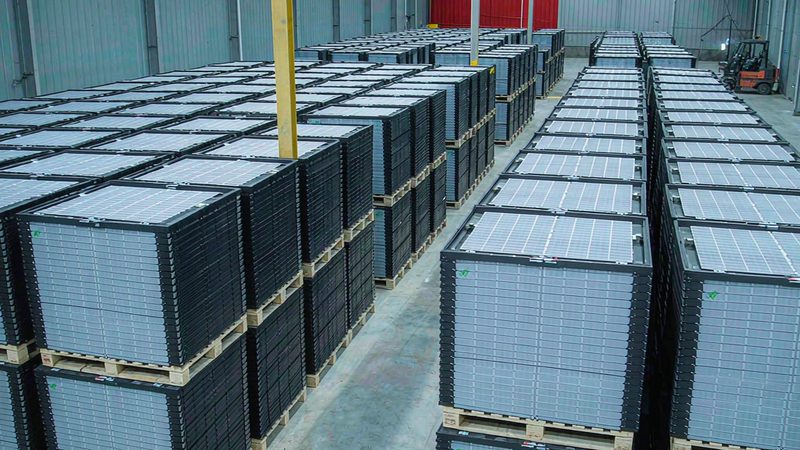
I pulled out our quotation records from last July to now and read them line by line. It's frightening.
This article lays out the fall, the causes, and how we responded.
The price curve
July 2025: mainstream P-type PERC modules, ex-works at 1.28 yuan per watt.
October 2025: 1.12.
January 2026: 0.96.
April 2026: 0.83.
July 2026: 0.71.
September 2026: 0.68.
Fourteen months, down 47 percent.
N-type TOPCon fell about the same, from 1.35 to around 0.70.
Why it fell this hard
First, capacity.
Starting in 2023, all four links — polysilicon, wafer, cell, module — expanded. The capacity came online all at once in 2025.
Nominal module capacity in 2026 exceeds 1,100 GW by industry counts. Global installation demand is about 600 GW a year.
Capacity is twice demand.
Second, technology turnover.
As the industry switched from P-type to N-type, old P-type lines lost their value — but the capacity is still there. Makers would rather run at a cash loss than shut down, because fixed costs run higher when idle.
Running at a cash loss means prices can't find a floor.
Third, regional gluts from trade barriers.
Some markets raised tariffs; cargo that can't go there diverts elsewhere. Wherever it diverts, a flood of goods arrives in a short window, and prices stampede down.
Who is losing money
The big integrated makers are losing gross margin.
Depreciation is the bulk of their cost. Their polysilicon is in-house, so costs are low. The module link loses cash, but the polysilicon link still earns. As a whole they can hold on.
Specialized module makers have it worst.
They buy wafers and cells at market and sell modules into a falling price. Squeezed from both ends.
Several I know ran below fifty percent utilization in the first half of 2026. One shut down in June.
Distributors and traders died in waves.
Anyone holding stock loses as prices fall. Someone who stocked five thousand panels last year, betting on a rise, is down hundreds of thousands by now.
Export traders like us are oddly less afraid of falling prices — we don't speculate on inventory and never hold more than a month's worth.
Where we stumbled
In September 2025 we signed a 500 kW order, priced at 1.15 yuan per watt.
Lead time was two months. Two months later, our purchase price had fallen to 0.98.
The customer knew about the drop and asked to re-sign at the new price.
Was the request reasonable? Yes. The contract said the price adjusts with the market.
We had added that clause ourselves to win the order.
On that deal we made no money — three thousand yuan, to be exact.
Since then we've changed our contract terms: price locked at signing, lock valid fifteen days; unpaid after fifteen days, we re-quote.
We explain this clause proactively, and customers accept it — it protects them too, because in a rising market we can't raise the price either.
Is the price drop good for us
Half good.
The good: stronger export competitiveness. A 0.68-yuan module, plus freight and tariffs, still lands cheaper than many locally made panels. Our inquiry volume tripled this year.
The bad: customers wait and watch.
Knowing prices are still falling, they hold off ordering. Waiting a month saves three percent — better than the return on investing now.
We've heard far more 'let's wait a bit' this year than last.
Our answer: price-lock agreements. Order today, and for three months the price holds whatever the market does. It takes a ten percent, non-refundable deposit.
We signed twenty-seven of these agreements this year; nineteen closed. Of the eight that defaulted, we kept the deposit on two and refunded six — those six were genuinely in difficulty, not acting in bad faith.
When does it bottom out
I don't know. I don't predict prices, because everyone who predicted was wrong.
All I can offer are a few indicators to watch:
One, polysilicon prices. Polysilicon is upstream; when it stops falling, modules usually follow two months later. It's still falling now.
Two, utilization. When industry-wide utilization breaks below fifty percent and stays there three months or more, that's usually the prelude to capacity clearing out.
Three, company count. In the first half of this year, more module makers exited the market than entered.
The clearing-out isn't over.
What we do
Three things:
No long inventory. Stock cycles kept under twenty days. In a falling market, less inventory is less loss.
Spot and near-month futures only. We don't bet on prices three months out.
Make service thick. When everyone's price is about the same, customers pick whoever can design the system, handle customs, and solve problems after arrival.
One line for buyers
If you need to build now, build now.
Waiting half a year might save you ten percent, but the power not generated in those six months is gone for good. At 0.6 yuan per kWh, a 100 kW plant loses 80,000 kWh in half a year — 48,000 yuan. What you save on modules may not beat that.
If you're not in a hurry, wait — but don't stockpile.