
One 36-Ton Excavator, 214 Photos
214 photos of one machine: what we shoot, how we shoot it, and why. This is our inspection photo checklist — take it and use it.
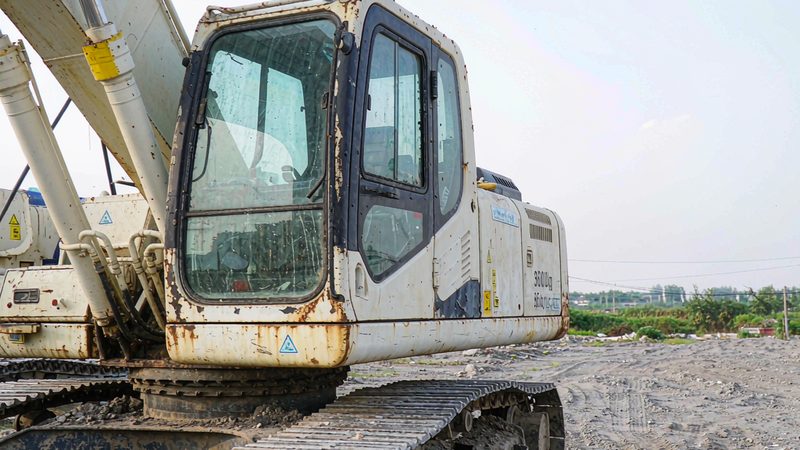
Every inspection report we issue carries at least 180 photos. For this 36-ton machine, I shot 214.
Some people think that's unnecessary. I say it's necessary, and here is why.
The machine
36-ton class, built in 2019, hour meter reading 8,420.
The previous owner worked it in a quarry in western Guangdong for six years.
When we bought it, the looks were average. The front-right counterweight had impact marks, and a palm-sized patch of paint was gone on the right side of the cab.
Honestly, that kind of appearance is a hard sell.
How the 214 photos break down
I sort them by area:
Exterior: 48. Four sides, four corners, roof, both sides of the undercarriage, counterweight, bucket.
Structures: 36. Welds on the boom, arm, and stick — one shot per weld point, plus a wide shot.
Hydraulics: 32. Main pump, control valve, cylinders, lines, fittings.
Engine bay: 24. Nameplate, intake and exhaust, belts, harnesses, oil pan.
Undercarriage: 22. Tracks, chain links, track rollers, carrier rollers, sprockets, idlers.
Cab: 18. Instruments, seat, control levers, A/C panel, glass, harness exits.
Nameplates and markings: 12. Chassis number, engine number, pump number, factory plate.
Details: 22. These matter most — more below.
What the detail shots are
Detail shots are the places with problems.
On this machine I shot these:
A repair weld at the base of the boom, about 22 centimeters long. I took a wide shot, a close shot, and one with a ruler.
The seventh link of the left track chain, pitch 1.2 millimeters over standard. Shot with the caliper in frame.
The fourth section of the control valve, slight seepage. I wiped it clean, took one shot, waited twenty minutes, and took another — you can see the oil weeping back out.
The cab floor: the rubber under the right foot is worn through to the base plate. Shot.
Sludge under the slewing bearing. I scraped a bit off to check the color. Shot.
Not one of these photos looks good.
Why shoot the ugly parts
Because what customers fear most is not a machine with problems — it's discovering the problems after it arrives.
We photograph the ugly, so the customer knows what the machine is while still in China. If he accepts it, he buys. If not, he doesn't.
We would rather he walk away now.
The photo that saved us once
In 2023 we shipped a machine to Ghana.
After arrival, the customer said a weld on the arm had cracked — he claimed we hit it during loading.
We pulled the pre-loading photos. The crack was already in the photos, fourteen centimeters long, and our report had flagged it as suspected old damage.
At the destination port, the customer measured 14.5 centimeters. Five millimeters' difference.
We compared the crack shapes in the photos. Same crack.
The customer saw the photos and dropped the claim.
Without that photo, we would have paid 18,000 dollars.
Our shooting rules
Rule one: every detail shot needs a reference. A ruler, a coin, or a finger — otherwise you can't tell scale.
Rule two: two angles. Front and side for every issue. A single photo can lie.
Rule three: nameplate in frame. Proof that this photo is of this machine, not another one.
Rule four: original files archived. No retouched images. Raw files kept three years, retrievable any time.
Video too
Besides photos, we shoot three videos per machine.
First, cold start. Filmed from the key turn to stable idle. This shows starting performance and exhaust smoke.
Second, function test. Boom, arm, bucket, swing, travel — each movement done separately and filmed. Listen for abnormal noise, watch the speed.
Third, after ten minutes at idle, check for leaks.
Videos are uncut, single take.
Take this checklist and use it
If you buy used machines yourself, shoot to this list.
You don't need this many, but these are mandatory:
Four exterior sides — four shots.
Chassis number and engine number — two shots.
Hour meter with nameplate — one shot.
All welds on boom, arm, and stick — one shot per weld.
Main pump and control valve — two shots each.
Track-link measurement — one shot.
Cold-start video — one clip.
Function-test video — one clip.
Twenty-odd shots, done in half an hour.
That half hour might save you tens of thousands.
About this machine
This 36-tonner did sell in the end.
32,000 yuan below market price, because of that 22-centimeter repair weld.
The buyer was a repeat customer. He saw the photos and said he could accept it.
The day he picked it up, I handed him a USB drive with all 214 original photos.
He said, your photos are more thorough than me coming in person.
I said, a trip here doesn't come easy for you.