
Twelve Years in This Trade — Three Things I Tell Newcomers to Think Through First
Last week a young man born in '95 came to the warehouse wanting to enter used-equipment export. Over tea, I told him the three pits I've stepped in over twelve years — each with a price tag attached.
July 3rd, a young man came to the warehouse — born in '95 — saying he'd saved 600,000 yuan and wanted to get into used construction-machinery export.
He asked me: "Brother Chen, is there still room to enter this trade?"
I didn't answer directly. I invited him to the office, brewed a pot of tea, and told him three stories. I lost money in every one, and I told him exactly how much.
He listened closely and filled two full pages of notes.
He'd been doing general merchandise in Yiwu, had a few East African customer contacts, heard machinery margins were high, and wanted to switch over. I told him: on the far side of high margins lie deep pits.
Anyone who moves hundreds of machines a year in this trade has a few loss stories in their pocket. Stories aren't worth money; remembering them is.
I also gave him the dumb-but-sound way to spend your first two years: one tonnage class, one shipping route. My first two years were nothing but 20-ton excavators to East Africa — until I could inspect them with my eyes closed.
A small plate can afford mistakes. Whoever wants to earn every kind of money steps in every kind of pit.
First: how many times can your capital chain snap
In this trade, money sits inside machines. Tens of thousands of yuan per unit, and from purchase to payment the normal cycle is three months.
In 2017, my third year in, I had six machines on my hands and my capital chain nearly snapped. Dollar payment terms stretched that year, customers dragged payments, and at the lowest my account held 90,000 yuan — payroll was in doubt.
I got through by cutting margins on two machines and moving them at cost. Those two earned 56,000 less — but they saved our lives.
I told the young man: your 600,000 buys you at most two machines parked. The rest is eating money — not one cent of it moves.
I've seen too many people profit on deal one, go all-in on deal two, and on deal three the chain snaps and they're out — people and machines together.
One more fact he needed: banks basically don't lend to this trade. Used machines have no standard valuation, so they can't be mortgaged. Your cash is your entire ammunition.
A peer I know held twenty machines at the 2018 peak; when the market turned he spent a year cutting losses to clear them. The man survived; his hair went half white.
There's no technique to the capital chain — only discipline. Split the account into three: buying money, turnover money, life-saving money. Nobody touches the life-saving money.
The young man asked how much life-saving money to keep. I said a hundred thousand of the six hundred thousand, immovable. He thought that too conservative. I said go ask the white-haired man from 2018 first.
Second: is your inspection skill enough
Big losses in this trade all come from misreading machines.
In 2019 I misread an excavator. Surface condition superb, only 4,000 hours. Half a month after we bought it, the main pump started knocking. Opened up: copper powder all through the hydraulics, the pump core scored.
Repairs ran 37,000 yuan; reselling meant another 20,000 markdown. Nearly 60,000 lost on one machine.
Later I learned the seller had changed the hydraulic oil and filters right before selling, washing away every symptom. In the trade that's called "washing the machine."
Inspection is a craft; without three to five years you don't get your hands in. Before you have it, don't touch big orders — or pay someone who knows to look with you.
Back then I paid Lao Li 1,500 yuan to inspect alongside me. The best money I ever spent.
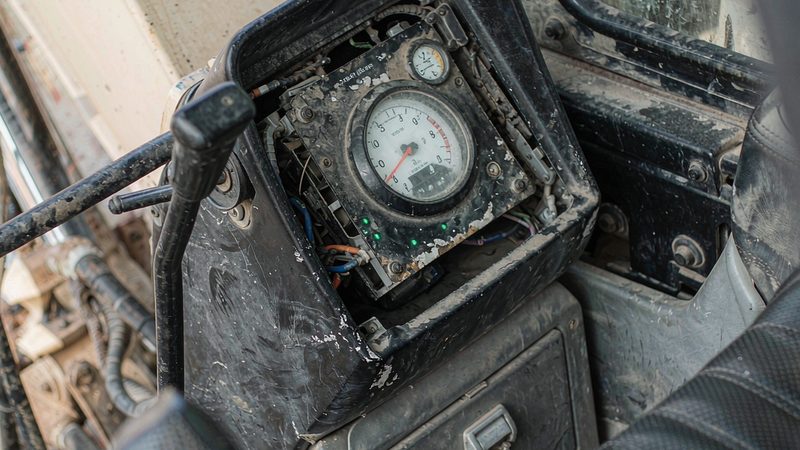
Washing techniques have upgraded over the years too. Rolled-back odometers are old news; now they swap whole instrument clusters — even the fault-code history comes out clean.
The counter is one: never read one spot, read ten. A cluster can be swapped; pedal wear can't, seat sag can't, the shine on the control levers can't. Machines talk — the question is whether you understand the language.
To this day I wear gloves when looking at machines, feeling piston rods and track pins by hand. The hand's memory beats the eye's — and it's built one machine at a time.
Third: do you dare carry the trouble after the sale
Once a machine leaves your warehouse, the trouble is just beginning.
In 2022, a bulldozer we shipped to Zambia threw a final drive after two months with the customer. By trade custom, responsibility for used equipment ends once it crosses the ship's rail.
But this customer was buying from us for the first time. I did the math: covering a parts kit plus guided repair cost 23,000 yuan. Don't pay, lose a customer. Pay, gain a long-term buyer.
I paid. That customer has now ordered eleven machines.
But you can't always afford to pay. One year the payouts clustered — 110,000 yuan out in three months, and that quarter the company worked for nothing.
The after-sales budget has to be reserved in advance. I hold three percent of sales, immovable.
Some choose not to pay. I know a dealer who sells and blocks the customer; he changed company names four times in three years. Last year he couldn't move a single machine — nobody in the circle dares take his goods.
This circle is smaller than you think. Buyers across Africa's markets all know each other. Burn one man and you've burned the whole list.
When the young man left
The tea finished, he asked: "Brother Chen, so can I do this or not?"
I said: a small plate of three machines or fewer — yes, you can. Plan the capital chain for the worst, learn inspection by the strictest standard, reserve after-sales at the thickest.
On his way out he asked if he could come back for advice. I said come — the warehouse never runs out of tea.
If he does enter the trade and loses money in year one, he'd better not come crying to me. Open this piece back up and read those three things — the road was his own choice.
This trade doesn't lack smart people. It lacks people who've lost money and still remember the pain.