
We Lay One Machine's Whole Ledger Open for the Customer
In September a customer asked how much we actually make off him on one excavator. I listed purchase price, reconditioning, freight, and duties line by line and sent it over. After reading it, he ordered a second machine.
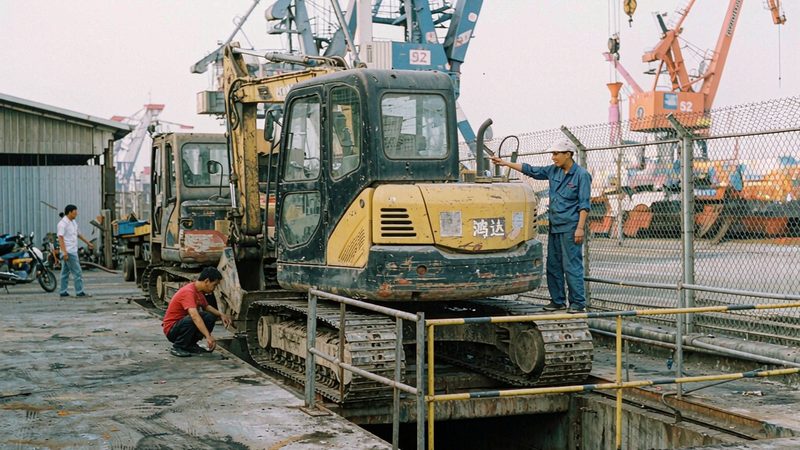
September 15th. On a video call, a customer in Ghana asked me: "Chen, how much do you actually make off me on this machine?"
In the old days I'd have said trade rules, pricing can't be discussed in detail.
This time I had Xiao Wang pull the ledger on that machine and walked him through it line by line. Video on, screen shared, receipts flipped through one by one.
He'd come through an old customer's referral and this was our first deal. Fair question — no blame in asking.
The ledger on that machine ran twenty-three pages. From his question to the last page, the call went forty-seven minutes.
The full ledger on this machine
A 2017 20-ton excavator, sold to him at a price equal to 520,000 yuan.
Purchase price: 398,000. Bought in Jiangsu from a small owner winding down his business; solid underlying condition.
Reconditioning: 26,000. Four track shoes, a full hydraulic-oil change, two cylinder seal kits, repaint and refinish, labor included.
Inspection cost: 4,200. Lao Li and me, two days — flaw testing, test runs, pressure tests.
Domestic freight plus lifting: 8,500. Jiangsu to Nansha Port, 1,400 kilometers.
Ocean freight: 39,000. A 40-foot flat rack, September rates.
Destination duties and clearance — paid by the customer, but we listed it for his reference anyway: about 42,000.
People ask why I list money the customer pays himself. Because only with the full ledger does he know the machine's true landed cost — and only then can he run his own business math.
Add it up: our cost was 488,000. Sold at 520,000, gross margin 32,000 — six-odd percent.
And that 32,000 doesn't all land in our pocket. Three months of capital tied up eats a few thousand in interest. Three percent is set aside for after-sales — 15,000 into a dedicated account. Spread yard and labor over it, and net profit per machine is around ten thousand.
I told him this layer too. He laughed: "Chen, you make less than I thought."
Make less, make it longer. Those are two different things, and I choose the latter.
Competitors laugh at me for being a fool. Fine, a fool then. Fools get the repeat customers.
Why we dare lay the books open
I can imagine competitors' reaction: you're insane, showing the customer your cards.
My math runs differently. What a customer really fears isn't you making money — it's not knowing how much you made off him.
Not knowing, he guesses the worst. Guess you made a hundred thousand and he bargains to the death, or just goes elsewhere.
Lay it open: 32,000 on the table. Reconditioning invoices, freight bills of lading, duty rate tables — whatever he wants to see, he gets.
We argued about it internally too. Some colleagues worried that knowing our costs would make customers bargain harder. I said try it; if it fails, we pull it back. Ten months in, not one deal has died over open costs.
Three deals went the other way — customers voluntarily added money after seeing the books, on parts and rush shipping. Knowing our margin, they topped up honestly.
How customers react after reading
The other end of the video went quiet for about half a minute.
He said: "Chen, I've bought eight machines. You're the first one who dared to do the math like this."
Three days later he ordered a second machine without even countering the price — and paid an extra USD 2,000 for us to stock a spare filter kit for his first machine.
By October he'd referred two fellow contractors to us. Both opened with the same line: heard your books are open.
Old customers reacted interestingly too. A Tanzanian customer of six years messaged just to ask: can I see the old ledgers?
Yes. Every ledger since 2019 is on file. We went through his fourteen machines one by one. His reply after reading was three words: "Never overpaid."
That customer then added an order for two more machines without a word of bargaining. He said: I've seen the books; haggling now would be bad manners.
We own the mistakes in our books too
Open books require clean books. We've added wrong before.
Last year on a loader, reconditioning missed a gearbox problem, only discovered at the port. The 18,000-yuan repair came out of our pocket, and that machine went from profit to a 6,000-yuan loss.
That entry is in the ledger too. Customers can find it — and we remember it even better.
Since then, gearboxes get pulled and inspected before any purchase. Better half a day more than gambling on luck.
The ledger rules are set: one page per machine — purchase, reconditioning, freight, payouts all recorded, kept five years, open to anyone.
Xiao Wang runs the ledgers now. He told me the biggest benefit of keeping these books: nobody dares slack off on a machine anymore. Every step has a name written next to it.
The ledger on that September excavator was later forwarded by the customer to his partner. The partner read it — and became a customer too.
You can ask your supplier the same way
Ask for the reconditioning list, the freight bill of lading, a redacted purchase contract.
If they can't produce them, or start mumbling — you have your answer.
One more thing to watch: books that look too perfect, every line exactly round, are usually fabricated. Real ledgers have rough edges — reconditioning overruns, freight fluctuations. Books that are too tidy are the fake ones.
We dare show our books because the real can't be faked — every line reconciles against bank statements.
A business lasts not on information gaps, but on both sides knowing the deal is clean.