
Used Concrete Pump Trucks: Boom Cracks Are a Red Line
I won't take a pump truck with a crack history in the boom, no matter how pretty the repair. In August, testing a 48-meter pump truck turned up two old cracks under the paint. The seller said they were fixed; I said you only get one life.
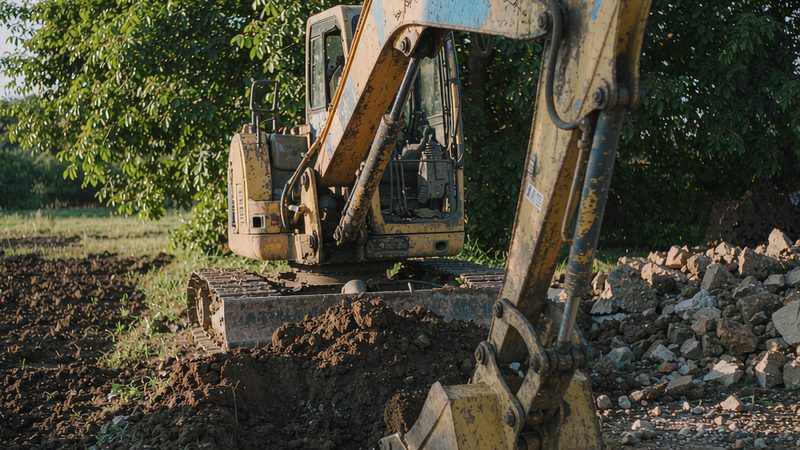
August 2nd, a parking lot in Foshan. A used 48-meter concrete pump truck; the seller said it had just had a major service, asking 850,000 yuan.
I brought an ultrasonic flaw detector. Not that I didn't trust him — a boom is something the naked eye doesn't get the final say on.
At the root of the second boom section, the waveform looked wrong. I ground off the paint: a weld seam underneath, its pattern clearly a later repair.
Tested the third-section elbow — another one. Two old cracks, both patched.
The seller leaned in and said they'd been repaired with imported electrodes. I didn't answer and kept testing the remaining sections.
The other three sections came back clean. But two was already enough. Rules are rules.
What a cracked boom means
A pump truck's boom unfolds over forty meters, concrete running through the hose at its tip, pumping for hours at a stretch.
Boom steel is a fatigue part. One crack means that spot has been pushed to its limit. Re-welding closes the seam but never restores the original strength.
I've seen what a boom failure looks like on a site. Vietnam, 2019: three boom sections snapped off at the root, crushing two site sheds. Luckily the workers got clear.
After that I pulled the records — that truck's boom had been re-welded three years earlier.
Booms are high-strength steel. Welding needs preheating beforehand and slow, insulated cooling after; a few degrees off and it fails. The torch-and-stick work at a roadside shop welds on a brand-new injury.
That's how most repaired booms come about. Crack it, find a shop to weld it, grind it, fill it, spray it — three or four days, under 5,000 yuan, and it looks factory-fresh.
From that day I set myself a rule: pump trucks with any crack history in the boom don't get bought. No matter how pretty the repair.
Our pump truck inspection sequence
Boom first. Ultrasonic testing on all five sections, focusing on roots and elbows — over three hours per truck.
Then the pumping system. Check the main cylinders for scoring, measure the delivery cylinder bores — anything past 0.5 mm of wear gets replaced. Pump a basin of water and watch whether pressure and changeover run smooth.
Third, the transfer case, which splits chassis power to the pumping system. Drain a little oil and check quality — metal shavings in the oil means an overhaul isn't far.
Fourth, the chassis. Pump truck chassis don't run far but run long in years. Check the frame rails for straightening marks and the tires for uneven wear.
The pump test also covers boom movement: full unfold and fold twice, watching for sticking and noise, and for hydraulic cylinder creep.
A pump truck's heart is the pumping system; its life is the boom. The heart can be repaired; the life can't be gambled.
A full inspection takes a whole day with crew and equipment — over 800 yuan in testing consumables and paint grinding. That money can't be saved.
In 2022 I bought a pump truck where the seller was pressing hard, and I skipped the flaw testing, doing only visual and a pump test.
The truck went to Egypt. In week three of pumping, the customer saw seepage at the second-section root. Local testing found a six-centimeter old crack. Return shipping wasn't realistic — we paid 52,000 yuan in repair and reinforcement costs.
Fifty-two thousand bought one rule: no flaw test on a pump truck, no deposit of a single cent.
Lao Li chewed me out over that one, and he was right. A 23,000-yuan flaw detector sitting unused in the warehouse is money thrown away.
How to spot a repaired boom
Paint over a repair is always newer than elsewhere. And a boom sprayed one uniform color all over actually deserves more suspicion.
Measure paint thickness with a gauge: filler over a re-weld reads high — 80 to 90 microns in normal spots, three to four hundred where it's been patched.
The flaw detector is the most honest. On the waveform, re-weld noise differs from base metal, and any tester with three years' experience sees it at a glance.
One more trick: check insurance and repair records. A truck with a snapped boom has almost certainly had a claim. One phone call to the insurer.
Before buying we always check three things: claim history, annual inspection records, and the original owner's site reputation. Only when all three line up do we talk price.
Running this process, we've rejected four pump trucks this year — all four with repaired booms.
How that truck ended up
The seller denied it at first, said it was a factory weld. I showed him photos of the test waveform and he went quiet.
Later he dropped to 720,000, saying the cracks weren't load-bearing. I still didn't take it.
Selling a truck like that isn't about a 130,000-yuan margin — it's about the lives of dozens of workers on a site. That's a risk I can't carry, and you shouldn't either.
I heard the truck later sold to someone else. All I can do is write what I found honestly into our work records. At least my conscience is clear.
Repaired-boom trucks have multiplied these past two years. When the pump truck market is weak, sites squeeze prices, owners over-pump, and booms fatigue faster.
Around Foshan and Dongguan, I can count four shops specializing in boom repair. Their craft keeps improving, so our testing has to keep getting finer.
It's a cat-and-mouse game, but the mouse can afford to lose. The cat can't.
That 850,000-yuan truck later sold for 720,000, I heard. Who the buyer was I don't know — I just hope he brought someone to run a flaw test.
Two lines to remember when buying a pump truck
Demand an ultrasonic boom report. Magnetic particle only reads the surface; it can't see inside.
If the seller won't allow flaw testing, walk. Shiny paint never tells the truth the way a waveform does.