
Buying a Used Crawler Crane? Don't Ask the Price — Check the Load Moment Limiter First
In February I inspected a 55-ton crawler crane at the Panyu warehouse — fresh paint, priced at 460,000 yuan, about 60,000 below market. I didn't bargain; I rejected it outright. One reason only: the load moment limiter had been bypassed.
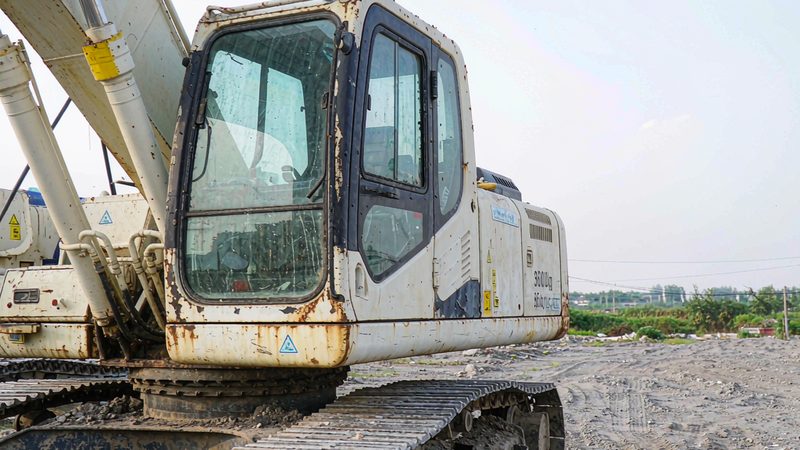
February 11th, Panyu warehouse. A 2008 55-ton crawler crane sat in the corner, freshly repainted, asking price 460,000 yuan.
Market price was around 520,000. Sixty thousand below market — something was off.
I didn't ask about price. I climbed into the cab first and looked for the load moment limiter.
The display on this machine was new, but the wiring had been spliced in later. Following the wires down, I found joints wrapped in black tape — not factory connectors.
I called Lao Li over. Nineteen years inspecting machines, he took one look and said: this one doesn't get bought.
What a load moment limiter does
While a crawler crane lifts, the computer is calculating in real time: at this radius, at this boom length, what's the maximum safe load.
Go 10% over, it alarms. Go further, it cuts the hoist motion outright.
Without it, the operator runs on feel alone. In lifting accidents, overload tip-overs make up the bulk — eight in ten involve a failed or removed limiter.
On the used market, cranes with removed or modified limiters have usually been run overloaded for years, or been in an accident. Removing it makes the machine look more capable than it is.
A factory computer-plus-sensor set costs over 60,000 yuan to replace. Whoever pulled it saved that 60,000 and bet nobody would notice.
Our four checks on a crawler crane
First, the load moment limiter. Does power-on self-test throw fault codes? Is the sensor wiring factory? Do the calibrated values match the actual boom length?
If conditions allow, hang a test block of known weight. Hang a five-ton block and the screen reads eight tons — the calibration is fake.
Second, the main boom welds. Magnetic-particle testing on the joints of all three boom sections — two hours per boom. For repaired welds, you have to tell an old repair from a cover-up of a fresh crack.
Third, the slewing system. Rotate the upperstructure three full turns unloaded, listen for knocking from the slewing bearing, then measure ring-gear backlash.
Fourth, the tracks. Measure track link pitch; past 5% wear the whole set needs replacing, and an imported set runs into six figures.
Those four checks take a full day per machine. There's no rushing it.
People ask me if I can compress it to half a day. No. Testing medium needs time to dry, oil temperature needs time to come up. Data gathered in a hurry is data I don't accept.
In my early years I chased speed — bought a machine after a three-hour inspection. I missed the wear on the track drive sprockets; a month into service the teeth broke and we paid 16,000 yuan in parts.
One machine, one day. That's the discipline this trade has taught me.
Machines waiting for inspection at the warehouse are booked into next month. For urgent orders, I pay extra for third-party testing — the rules don't change.
What happened to that crane
We peeled back the tape: two wires inside were shorted together. Shorted means the alarm is permanently bypassed.
I sent the seller seventeen photos. He went quiet for half a day, then replied: if you don't want it, plenty of people do.
That I believe. Machines like this mostly flow to places with loose oversight, and when something happens, the bill never reaches him.
I'm not earning that money. Sell one machine like that and you smash a reputation built over ten years.
In March I asked that seller again — the crane had sold. Where to, he wouldn't say. I just hope whoever bought it climbed into the cab during inspection.
A 460,000-yuan crane, 60,000 under market — and a factory limiter set alone costs 68,000 to replace. Whoever grabs that bargain fills the hole that comes with it.
The money I've lost on this
I got burned in 2020 too. A crawler crane — limiter present, self-test passing — and I skipped the test-block calibration.
The machine went to Kenya. On day seven of lifting, the customer had alarms jumping all over. A recalibration showed the sensors had drifted long ago. We paid calibration fees plus downtime compensation — 28,000 yuan.
Since then, crawler cranes get a test-block calibration, period. The warehouse keeps two standard weights: one two-ton, one five-ton.
Let me be specific about block calibration. Once the weight is in the air, you watch three numbers at once — radius, load, and moment percentage — and it only passes if all three agree.
In 2023 in Jiangmen I saw a 50-ton crawler crane with no limiter tip over. The lifting crew overloaded it on a bundle of rebar, the boom folded, the crane went into a pond, and the operator jumped clear with his life. The owner was fined into six figures and the site stopped for twenty days.
Some machines have limiters that are present but re-parameterized. The alarm threshold, originally 90% of rated, gets changed to 110%.
That kind passes self-test and even shows numbers under a test block — only back-calculating against the boom-length/radius chart exposes it. That's why a full page of our inspection sheet is dedicated to back-calculating calibration values.
Sellers' faces usually go dark when they see me flip to that page. Dark is right.
Our inspection sheet has thirty-two items, plus eight crane-specific extras. When a sheet is filled out, I sign it myself first.
The signature means: if I missed a fault on this machine, I pay for it.
The sheet travels with the machine. The customer gets a copy; the original is archived for five years.
Ask for these three things before you buy
One: a video of the limiter's power-on self-test, recorded from the moment of power-up, uncut.
Two: a testing report on the three boom-section joints — or bring your own people to test on-site.
Three: maintenance records over the years — check whether the boom or the slewing bearing has ever been replaced.
If all three aren't there, don't talk price no matter how low it goes. This is experience I paid for in losses — free of charge to you.