
In Africa, Repairable Beats Cheap
A machine 30,000 yuan cheaper, then two months waiting for parts and 200,000 yuan of downtime. I spent four years in Africa; let me run the numbers for you.
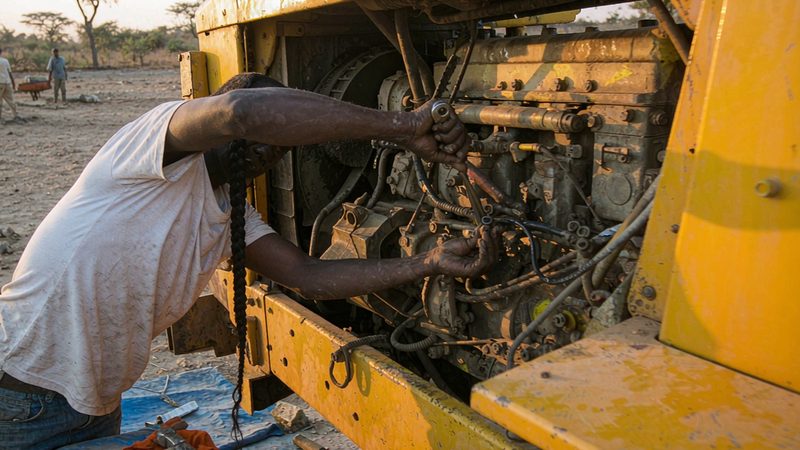
I spent two years in Tanzania and over a year in Kenya — four years in all.
The most important thing those four years taught me: over there, a machine's value is not in the purchase price, but in how fast it can be fixed after it breaks.
The math on one machine
A real example.
A twenty-ton excavator working on a project.
Option A: our machine at 620,000 yuan, with a commitment to ship parts within forty-eight hours, and air freight for urgent items, arriving in three days.
Option B: another dealer's machine at 590,000 yuan — thirty thousand cheaper — but parts take time: fifty-five days on average from order to receipt.
B looks thirty thousand cheaper.
Now run the downtime math:
That machine earns eight to twelve thousand yuan a day on site; call it ten thousand.
Assume one parts-requiring breakdown in a year — hardly an overestimate.
Option A: parts arrive in three days, one day to repair, four days down, forty thousand lost.
Option B: parts arrive in fifty-five days, one day to repair, fifty-six days down, 560,000 lost.
A gap of 520,000 yuan.
Against that 520,000, a thirty-thousand price edge means nothing.
Why parts are so slow
A few reasons.
First, no local stock. Most parts ship from China: thirty to forty-five days by sea, plus ten for clearance.
Second, wrong part numbers. For used machines, part numbers differ across model years. Send the wrong one, wait another round.
Third, sellers don't take responsibility. Once the machine is sold, the seller owes no parts support; the customer searches locally and finds nothing.
Fourth, long payment and clearance chains. Some parts sit a month in port clearance — not slow transport, slow paperwork.
What repair looks like over there
A few things I've seen.
In Dar es Salaam there's a workshop whose owner is called Joseph. He keeps three old excavators just for stripping parts.
A customer's machine breaks; Joseph pulls a part off a donor and bolts it on. Not a by-the-book practice, but fast — the machine works the same day.
Stripped parts cost thirty to fifty percent of new, with uncertain life — maybe three months, maybe three years.
Another way is field repair. A welder takes his machine to the site and welds cracked seams on the spot. People in China would laugh at this, but over there it's normal.
I've seen a stick welded seven times, still working.
And there's adaptation. When a part can't be found, a part from another model gets modified to fit. I've seen a truck leaf spring turned into an excavator bucket.
What we do
First, every machine ships with a wearing-parts list.
The list gives the part numbers of the fifteen most-used wearing parts for that machine, so the customer can stock ahead.
Fifteen parts, about 12,000 to 20,000 yuan in total. We advise customers to take them with the machine.
Those fifteen parts cover seventy percent of the machine's common failures.
Second, parts inventory.
Our Guangzhou warehouse keeps 1.4 million yuan of parts on hand. Regular parts ship within forty-eight hours of ordering.
Urgent items go by air, reaching major cities in three days. Air freight is dear — about 1,200 yuan for a fifteen-kilogram part. Against downtime losses, worth it.
Third, teach local repair.
We send customers maintenance manuals in Chinese and English, illustrated.
Last year we ran a training session in Nairobi: thirty-one attendees, two days of common-failure diagnosis.
The training was free. Someone asked why free. I said, once they can fix things, I sell more machines.
What breaks most
Ranked by our shipping records:
First, bucket teeth and adapters. Consumables rather than failures, but replaced most often.
Second, hydraulic hoses. Rough site conditions; rubbed-through hoses are routine.
Third, track links and track rollers. Lots of running on rock wears them fast.
Fourth, oil seals. Leaking cylinder seals are the most common hydraulic failure.
Fifth, batteries and starter motors.
Sixth, sensors. The most troublesome, because they need diagnosis — not just swap-and-go.
We stock the first four deeply. Sensor types are too many to stock fully; we keep some per model.
A real pitfall
In 2024 we sold a machine to Zambia.
Three months in, the customer reported swing problems and asked for a swing motor.
We shipped the part. It was installed — no fix.
It turned out the problem was not the motor: the swing gearbox had lost all its gear oil and the gears were chewed up.
We sent the wrong part. The fault was ours — we shipped without making the customer diagnose first.
Afterward we changed the process: when a customer reports a fault, we ask for video first — watch the movement, listen to the sound, check hydraulic pressure — and only then ship parts.
This made shipping two days slower, but our wrong-shipment rate fell from 18 percent to 3 percent.
Advice for peers heading overseas
First, build parts capability before selling machines. Without it, don't go.
Second, teach customers common-failure diagnosis with video, not text.
Third, don't sell models you don't know yourself. Obscure models can't be repaired locally, and customers will hate you.
Fourth, keep a local contact. Not an agent — someone who answers the phone. That matters more than anything.
One last line: over there, a repairable machine is worth far more than a cheap one. Many newcomers only learn this after paying for the lesson.