
We Spent Nine Days Sorting This Batch of Down Jackets
Out of 40,000 pieces of used winter clothing, 23,000 made the export grade. Nine days, twenty-six people. Here is our grading standard, line by line.
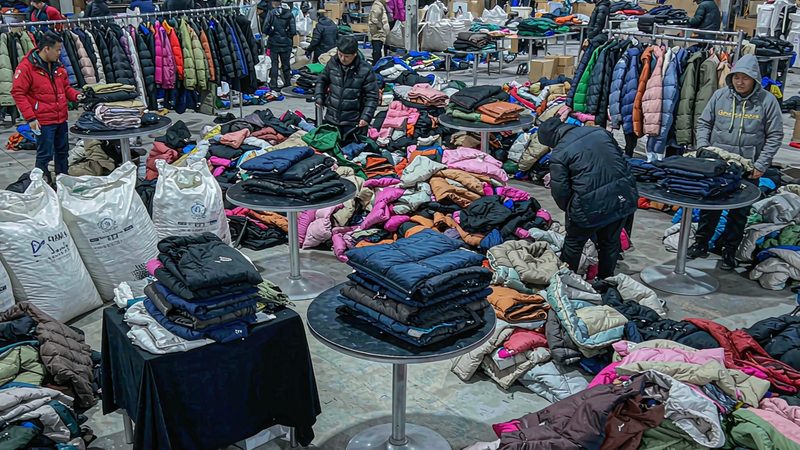
July 19 to July 27, in our sorting warehouse in Dongguan: twenty-six people, nine days.
The goods were 41,000 pieces of used winter clothing, mostly down jackets and padded coats.
23,100 pieces made export grade. Of the remaining 18,000, some went to domestic sales, some to disposal.
This article is about how we sorted.
Where the goods came from
Three channels.
One: recycling points in East China — 21,000 pieces, about half.
Two: returned and excess stock from two brands — 12,000 pieces. Best condition; many still had tags on.
Three: scattered buy-ups — 8,000 pieces, worst condition.
Goods from all three channels were mixed and regraded from scratch.
Our five grades
Grade A: nearly new. Tags attached, or worn once or twice, zero flaws. Nine percent of this batch — 3,700 pieces.
Grade B: light signs of use. Possibly slight pilling or faint wash marks; no damage, no stains, zippers intact. Twenty-eight percent — 11,500 pieces.
Grade C: obvious wear, fully functional. Possibly small stains, slight fading, localized abrasion; zippers and buttons all work. Thirty-one percent — 12,700 pieces.
Grade D: flawed but wearable. Repaired damage, visible stains, zippers rough but working. Nineteen percent — 7,800 pieces.
Grade E: scrap. Thirteen percent — 5,300 pieces.
The export bar
Our African customers take grades A, B, and C.
Grade D goes to domestic sales and Southeast Asia — low unit price, but it moves volume.
Grade E becomes industrial rags and recycled fiber. No money in it; it's just disposal.
So the 23,100 export pieces are the actual count of A+B+C.
How twenty-six people split the work
Day one: rough sort. Everyone together, pulling out the obviously scrapped. 4,200 pieces went out that day — moldy, moth-eaten, or heavily torn.
Days two to four: sort by type. Down jackets, padded coats, shell jackets, wool coats — four lines.
Days five to seven: grading. The slowest step; each person gets through about four hundred pieces a day.
Day eight: re-inspection. Graders never check their own work — cross-check only. 310 pieces turned out misgraded, mostly between C and D.
Day nine: baling. Compressed bales of twenty kilograms each.
How to judge a down jacket
First thing we teach new people: squeeze.
Grab a corner of the jacket, squeeze, release. Good down springs back at once; slow rebound means low down content or moisture damage.
Second: slap it. Hang it up and slap it a few times, watching for escaping down fibers. Lots of fibers flying means poor down-proof fabric.
Third: feel the quilting seams. Hard lumps along the quilted lines mean clumped down — the jacket was washed and never dried through.
Fourth: smell it. Any mildew smell means an immediate downgrade — nothing above C.
Fifth: read the wash label. It states down content and fill weight. A label claiming 90 percent down on a jacket that feels feather-light is a problem.
The three hardest calls
First: yellow spots on light-colored down jackets. Could be oxidation from long storage, could be sweat stains. We grade them all C. No gambling.
Second: broken zipper on an otherwise nearly new jacket. Two camps in the team: replace the zipper and grade it B, versus straight to C.
We settled it with a rule: when an original zipper fails, a replaced zipper never grades below B — because we replace with YKK, better than many originals. The rule is written into the standard.
Third: branded goods in mediocre condition. Some say a brand deserves a higher grade. We disagree — the customer buys a garment, not a logo. Brand affects price, not grade.
What we got wrong
On July 26, re-inspection caught 310 misgraded pieces.
180 of them were C graded as B. Cause: a few pieces had stains that faded after washing, and graders judged them clean.
120 were D graded as C. Cause: holes under the arms, invisible on a hanger.
10 were A graded as B. That was us being over-conservative; those ten had tags on.
310 pieces is 0.8 percent of the total.
We're not satisfied. The target is within 0.3 percent.
Our grading standard runs twelve pages
Seven revisions since the first version in 2019.
Every standard comes with photo examples — over three hundred.
New staff train three days, then test on day four. Fail the test, and you don't grade.
We show this standard to customers. They inspect against it; if we don't match it, we own it.
Pricing
Grade A export price, down jackets: 42 yuan a piece.
Grade B: 29 yuan.
Grade C: 18 yuan.
FOB Guangzhou, freight excluded. Twenty-kilogram bales; a 40-foot container holds about nine hundred bales.
Prices move with the market; these numbers only represent July.
If you want this batch
We still have over three thousand pieces of A and B left.
Come see the goods in Dongguan, or ask us to shoot video.
We film every bale being opened, pulling three pieces at random for a close look. Ship only when you approve.
Don't judge by sample bales. Sample bales are cherry-picked and show nothing real. If you check, pull random bales.