
We Don't Touch the Number on the Hour Meter
How many hours a machine has run is the most critical number on a used unit. Roll it back and you can sell for 80,000 yuan more. Here is how we check it — so you can check it yourself.
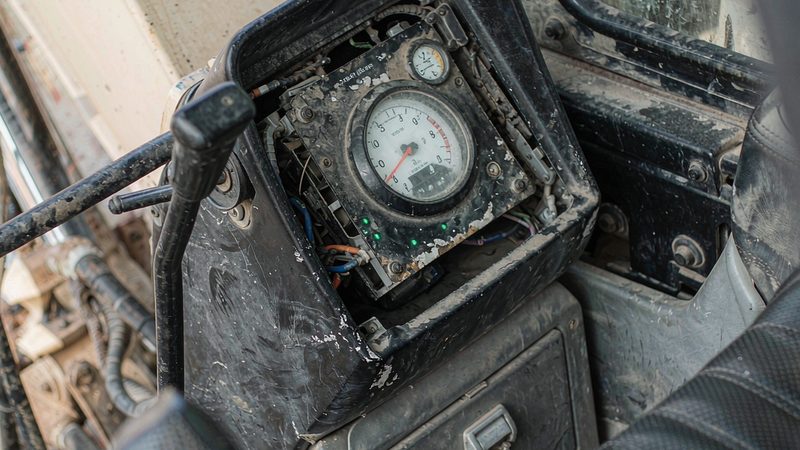
A customer asked me: are the hour meters on your used machines real?
I said, I can't make you trust me. I can only let you check for yourself. This article lays out the full method.
Money first
On a twenty-ton excavator, ten thousand hours off the meter is worth eighty to a hundred and twenty thousand yuan more in China.
Eighty thousand yuan is enough for the tamperer to buy a car.
So in this trade, a rolled-back meter is not news. An honest one is.
How we check when we buy a machine
When we take in a machine, we verify hours four ways, and all four have to agree before we buy.
First: read the meter. Mechanical and electronic meters both, photographed for the archive.
Second: read the engine ECU. Most brands log running time in the engine computer, a separate system from the dashboard. Plenty of people who tamper with the dash never touch the ECU.
Third: look at wear. The crudest method, and the most accurate.
Fourth: check maintenance records and the machine's history.
What wear to look at
Let me give you specific spots.
Track chain links. Measure the pitch of a chain at fifteen thousand hours and one at twenty-five thousand, and you'll know. We bring a vernier caliper and measure the total length of ten links. Pitch per link is a standard value when new, and it stretches with wear. More than three percent over, and the machine's real hours are almost never below twenty thousand.
Grease on the slewing bearing. This one is even more telling. The slewing bearing gets greased every five hundred hours; over-greasing squeezes out and builds up as sludge under the ring gear. The thickness and color of that sludge tell you how many times it's been greased.
The cab floor. Rubber flooring stood on for five thousand hours wears differently from twenty thousand. We compare with a coin: heel-wear deeper than two millimeters means no fewer than eight thousand hours.
The seat. How far the seat foam has collapsed correlates directly with hours sat. This one is judgment, but Lao Li has been reading seats for over twenty years; his error stays within two thousand hours.
Where we got burned
In 2021 we took in a machine. All four checks agreed: nineteen thousand hours.
Three months after it hit our warehouse, a fellow trader came to look and said he'd seen this machine before — back in 2018 its meter already read thirty-two thousand.
We checked again. The ECU said thirty-one thousand eight hundred.
Someone had swapped the ECU module. Our equipment at the time couldn't detect the difference, because the replacement was the same model, same year, with a genuine serial number.
In the end we sold that machine at thirty-one thousand eight hundred hours — sixty-eight thousand yuan below what we paid. A loss.
After losing that sixty-eight thousand, we added a fifth check.
The fifth check
Check the machine's hydraulic pump numbers.
The pump carries a casting batch number and a factory serial; the serial encodes the year. If a machine left the factory in 2018 but its pump was replaced in 2023, the odds are it ran well past fifteen thousand hours around its overhaul window — under normal use, nobody swaps a pump at that point.
This method isn't a hundred percent accurate, but it screens out more than half of the ECU-swap tricks.
From 2021 to now, this method has caught eleven problem machines. Of the eleven, we rejected nine; two we bought, but priced at their real hours.
How we show you the numbers
For every machine we take four photos:
The dashboard hour reading, framed with the nameplate, which carries the chassis number.
The ECU readout screen showing running time, with that day's newspaper or a phone clock beside it.
The track-link measurement, with the caliper reading clearly legible.
A close-up of the slewing-bearing sludge.
These four photos come to you together with the inspection report number. Show them to anyone you like, including people in the trade.
If you catch us wrong
Last year a customer received a machine, had the ECU read himself, and got a figure twelve hundred hours above what we reported.
He contacted us. We checked our own archive and found we had misread the meter by one digit — the last digit was in shadow and we read it wrong.
We refunded him 15,000 yuan.
Not much money, but it was our mistake. We wrote it into the inspection procedure: hour-meter readings must be taken independently by two people, cross-checked, and signed.
Why I'm writing this
Because someone asked me: why should we believe you?
I can't answer why you should. I can only publish the method and let you check.
If you check and find us wrong, we pay. That promise isn't in the contract; it's written here, and it counts just the same.